Personal Project · AI-Augmented Workflow · 2026

How I Redesigned
My Design Process with AI

A two-gate workflow with a verification layer, designed the way I design everything else — with intent, constraints, and evidence.

Role Designer & BuilderSolo — design, architecture, implementation, QA
Project MaiLLYGmail-connected AI mail client
Platform Web · Gmail API integration
Duration Feb–May 2026 (v1)+ 1-day sprint for v2
Team 1Solo — with AI as a directed, verified collaborator

Hook

As a Senior Product Designer, my job is to remove friction from complex systems. In 2026, I turned that discipline on my own process: I rebuilt how I design and ship — with AI as a collaborator that I direct, verify, and review like a team member. The proof is MaiLLY, a Gmail-connected AI mail client I designed, built, and deployed alone.


The Problem

AI agents like Claude Code act directly on your codebase. That power cuts both ways: vague prompts produce changes that contradict your architecture, and "done" reports aren't always true. Most designers either avoid agents entirely or accept the chaos. I wanted a third option — a process where AI moves fast and I stay accountable for quality.


The System: A Two-Gate Workflow
with a Verification Layer

01

Gate 1 — Design in chat.

Requirements, trade-offs, and edge cases are argued out in conversation until the intent is unambiguous. Only then does a prompt get written.

02

Gate 2 — Execute with constraints.

Every prompt handed to the agent carries standing guardrails: scope limits ("do not touch the briefing API"), governance rules (no new packages, no logging of email content or keys, temporary debug logs must be deleted before commit), and design-system enforcement (all values reference tokens — no hardcoding).

03

The Verification Layer.

This is what makes the system trustworthy. Every prompt ships with an external checklist — kept outside the prompt itself — defining what evidence I need before accepting completion: real JSON responses, actual screenshots, root-cause explanations. A report that says "fixed" without evidence gets sent back. For bug fixes, prompts explicitly forbid guess-fixes: the agent must investigate hypotheses I enumerate, log what actually happened, and identify the cause before changing code.

04

Model allocation as a design decision.

I match model capability to task complexity: a frontier model for strategy and problem reframing, a mid-tier model for implementation, and a fast, cheap model inside the product itself for high-frequency AI features. Cost-aware AI architecture is part of the design.

05

A living roadmap as shared memory.

Project state lives in a single Notion document with a "NOW" marker, decision log, and per-phase checklists — readable by me, by chat sessions, and by coding agents alike. Any session, human or AI, starts from the same truth.


Proof 1 — MaiLLY: a workflow built over months,
proven in a one-day sprint

MaiLLY didn't start as a one-day build — the AI-collaboration system behind it was forged over three months of shipping v1, and v2's single-day sprint was possible because that system was already mature.

MaiLLY in action — the Gmail-connected AI mail client designed, built, and shipped through this workflow.

Establishing the discipline (v1, Feb–May 2026). Early prompts were single fixed instructions; by mid-April, after an underspecified prompt caused a regression, I standardized every prompt around explicit scope boundaries. By May, lib/tokens.ts had become the single source of design truth — replacing what would traditionally be a Figma file — with a standing rule I later put in writing: read tokens.ts before touching any visual, no exceptions.

Verification became non-negotiable. I didn't accept a single AI security audit as sufficient — I re-ran the same audit prompt four times until it returned a clean pass, catching a legacy endpoint and an exposed error detail that earlier rounds missed. When a hardening change broke the app in production, I reverted immediately on confirmed regression rather than defending an untested assumption. And the most consequential bug I caught wasn't found in code review at all — it surfaced only when a friend used the product live, next to me, and a multi-turn conversational flaw appeared that no unit test would have caught.
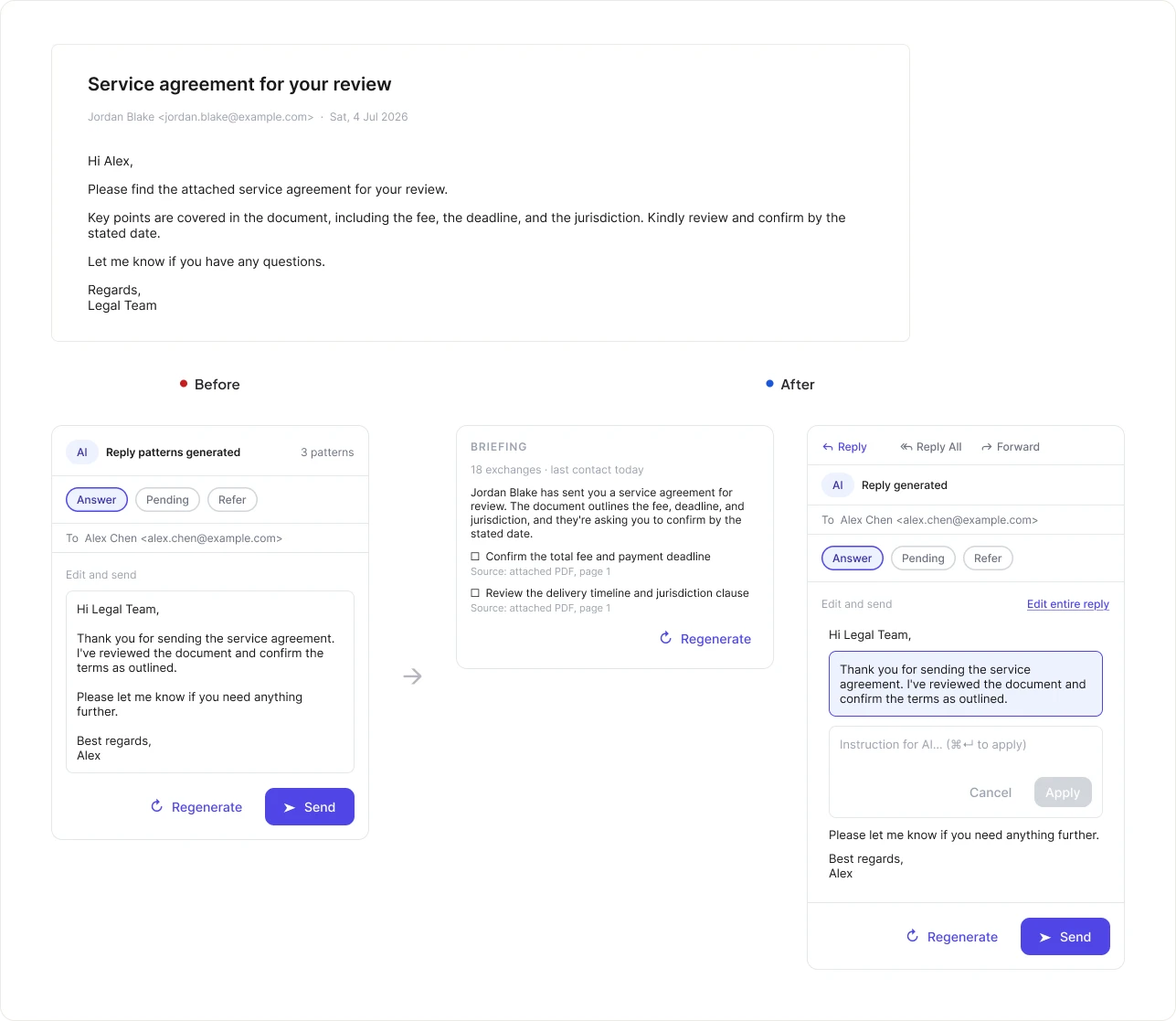
Before and after comparison of the MaiLLY reply panel, showing the shift to a single reply pattern with in-panel reply actions
Before (v1) → After (v2): unified reply-pattern selection, in-panel reply-mode actions, and a link-styled edit affordance — all caught and corrected through the verification layer described above.

Product judgment stayed mine. I scoped MaiLLY by what I explicitly excluded — no reimplementing Gmail's search, folders, or filters — reasoning later distilled to: the moment you add a fourth verb, the product stops being about one thing. I chose privacy-by-default (AI drafts only on explicit click, not automatically) over a lower-friction default, then deliberately deferred re-litigating that tradeoff until enough user signal existed to justify revisiting it.

When the plan didn't work, I changed the method — not the standard. My research plan depended on user interviews; when the pipeline stalled post-launch, I didn't wait. I pivoted to hypothesis-driven personas built from competitive analysis and the sparse signal I had, and logged the pivot as a constraint-driven design decision — not a failed process. A competitive audit against Gmail Gemini and Superhuman later forced a harder conclusion: MaiLLY was undifferentiated. I didn't rationalize the gap; I used it as the trigger for the UX redefinition that became v2.

The one-day sprint. All of that discipline — scoped prompts, a token-based design system, an evidence-based verification habit, hard-won product judgment — is what let the v2 build (briefing AI, edit modes, reply types) go from design tokens to a deployed, working feature set in a single focused day. The speed was a result of the system, not a substitute for it.


Proof 2 — Validating before building

When I identified a workflow gap worth productizing, I didn't start building. I ran a structured market study first: 12+ competitors analyzed, target segments sized, pricing benchmarked. Designer instinct, PM discipline.


Proof 3 — The workflow transfers

The same system runs my client work. For a B2B client, I used AI-driven analytics and heatmap analysis to ground a web redesign in behavioral data rather than opinion. Same gates, same verification discipline, different context — personal product, client work, and (previously, at Rakuten) platform-scale product all run on one process.


What Changed

01

"Done" now means verified. Evidence-based acceptance turned AI from a fast-but-unreliable intern into a dependable collaborator.

02

I ship alone what used to need a team — design, architecture, implementation, QA — while keeping each discipline's standards.

03

My process itself became a designed, documented product: constraints, checklists, decision logs, and a roadmap any collaborator — human or AI — can pick up cold.


Reflection

The lesson isn't "AI makes you faster." It's that AI amplifies whatever process you bring to it. Bring vagueness, and it ships vagueness at speed. Bring clear intent, enforced constraints, and evidence-based review, and it ships your standards at speed. The skills that made this work are the ones design always demanded: knowing what you want, knowing how to verify it, and knowing what not to automate.

← Back to all case studies